MODULE 04 / FAQ
Frequently Asked Questions
Direct answers to the most common questions about the BPC-157 research literature.
- Get direct answers to the most-searched questions about BPC-157 without wading through the full research module.
- Understand where the evidence is strong, where it is limited, and where it is absent.
- Understand the regulatory and compliance context clearly and without ambiguity.
Compound and Mechanism
What is BPC-157 and where does it come from?
BPC-157 is a synthetic 15-amino-acid peptide with the sequence GEPPPGKPADDAGLV and a molecular weight of 1419.5 Da. It was derived from a protein isolated in human gastric juice — not identical to any naturally occurring peptide, but based on a fragment of a naturally occurring gastric protein. It is classified as a pentadecapeptide (15 amino acids). In the published literature it also appears as Stable Gastric Pentadecapeptide BPC 157 and PL 14736 (the topical enema formulation studied in IBD trials). Synonyms: BPC157, Pentadecapeptide BPC 157.
---
How does BPC-157 work at the molecular level?
The mechanistic picture that emerges from rodent studies centers on four primary nodes. First, BPC-157 upregulates VEGFR2 (vascular endothelial growth factor receptor 2), the primary driver of endothelial cell proliferation and angiogenesis. Second, it activates the Akt-eNOS signaling axis, increasing nitric oxide production, which drives vasodilation and promotes cell survival. Third, it activates ERK1/2 and the FAK-paxillin pathway, promoting fibroblast proliferation and collagen synthesis. Fourth, it downregulates NF-kB, a master regulator of inflammatory cytokine production, while simultaneously increasing eNOS-derived NO and decreasing iNOS-derived (inflammatory) NO [4][5][11].
Importantly, these effects are tissue-context-dependent: BPC-157 promotes angiogenesis where healing requires it (tendon, muscle) while opposing pathologic neovascularization in other contexts (corneal models, cirrhosis models). Sikiric et al. (2025) describe this as a 'beneficial pleiotropic effect' rather than simple angiogenic stimulation [11].
---
What tissues has BPC-157 been studied in beyond the gut?
The published literature spans a wide range. In musculoskeletal tissue: Achilles tendon detachment and healing [2], tendon fibroblast cultures [3], quadriceps muscle-to-bone reattachment [12], and crushed or transected muscle and tendon [1]. In neurological models: hippocampal ischemia-reperfusion [5], spinal cord compression [6], and dopaminergic system disturbances [7]. In cardiovascular models: pulmonary arterial hypertension [8], major vessel occlusion including Budd-Chiari syndrome and portal hypertension [9], and lower-extremity ischemia-reperfusion with remote organ protection in liver, kidney, and lung [14]. In wound healing: skin incisions, burns, diabetic ulcers, and gastrointestinal fistulas [4][15].
Dosage and Administration
What are the research doses of BPC-157 used in animal studies?
The most common systemic dose in rodent studies is 10 μg/kg/day intraperitoneal. Many studies also include 10 ng/kg and 10 pg/kg arms, and all three are typically active. This span of seven orders of magnitude — from picograms to micrograms per kilogram — is unusual and has been documented across wound healing, tendon healing, pulmonary hypertension, and gastrointestinal models [2][4][8][12][15]. The 2025 pleiotropic review confirmed no lethal dose in mice at 2 g/kg IV or intragastric, suggesting an extremely wide therapeutic index in rodent models [11].
For pharmacokinetic characterization, higher doses were used: 20–500 μg/kg intramuscular in rats and 6–150 μg/kg in dogs [10]. For spinal cord compression, 200 μg/kg and 2 μg/kg were studied in a single-dose protocol [6].
---
What is the half-life of BPC-157 and how is it metabolized?
Following IV administration, BPC-157 has an elimination half-life of approximately 15.2 minutes in rats and approximately 5.3 minutes in beagle dogs. It is metabolized into its constituent amino acids via urine and bile pathways. Linear pharmacokinetics were confirmed, meaning plasma exposure increases proportionally with dose. No accumulation was observed on repeated dosing. These findings come from the pharmacokinetic study by He et al. (2022) in Frontiers in Pharmacology [10].
---
What routes of administration have been studied in animal research?
Nine routes appear in the published literature: intraperitoneal, intravenous, intramuscular, oral gavage, ad libitum drinking water, topical cream, local wound application, ophthalmic drops, and intragastric gavage. The intraperitoneal route is the most common. Several studies compare two or more routes within the same experiment and report consistent activity across routes, including oral [4][8][12][15].
---
How does BPC-157 compare in activity when given orally versus by injection in research models?
Multiple studies report active effects via oral delivery — including the pulmonary hypertension model (oral in drinking water vs intraperitoneal, comparable outcomes) and the quadriceps reattachment model (oral gavage followed by drinking water) [8][12]. The pharmacokinetic study by He et al. (2022) found very low oral bioavailability in rats (plasma exposure was substantially lower than after IM injection), which creates an apparent paradox [10]. BPC-157's stability in the gastric environment — a property by design, given its gastric protein origin — may allow direct local tissue effects in the gastrointestinal tract. For systemic effects distant from the gut, the mechanism underlying oral efficacy at low circulating concentrations is not definitively explained in the literature.
Human Data and Safety
Is there any human clinical data on BPC-157?
Yes, but it is extremely limited. The 2025 narrative review by McGuire et al. in Current Reviews in Musculoskeletal Medicine identified exactly three published human studies [13]. Study one: intra-articular knee injection in 14 patients, with 87.5% (12 of 14) reporting significant pain relief. Study two: intravesical injection for interstitial cystitis in 12 patients, with 80–100% symptom resolution. Study three: an IV safety study in 2 healthy volunteers receiving doses up to 20 mg total, with no adverse events and no clinically meaningful changes in laboratory parameters; plasma BPC-157 returned to baseline within 24 hours.
These three studies total 28 participants. No Phase 2 or Phase 3 randomized controlled trials of BPC-157 have been completed as of 2025. The related compound PL 14736 (a topical enema formulation) was taken into Phase 2 trials for IBD but did not advance. McGuire et al. explicitly state that rigorous RCTs are required before any clinical conclusions can be drawn.
---
What safety signals have been observed in the published literature?
In the rodent literature, BPC-157 has not produced a lethal dose at 2 g/kg IV or intragastric in mice [11]. In the three small human pilots, no adverse events were reported in any participant [13]. There are no published long-term human safety or toxicology studies. The concern about pathologic angiogenesis stimulation in cancer contexts has been raised in the literature, but the 2025 pleiotropic review notes BPC-157's selective tissue-context-dependent effects include opposition of pathologic neovascularization in certain models — making this a more nuanced question than a simple 'pro-angiogenic' classification would suggest [11].
In any event, the absence of reported adverse events in the limited human data and the rodent safety profile do not constitute a human safety demonstration, because neither dataset is adequately powered or designed for that purpose.
---
What is the WADA status of BPC-157?
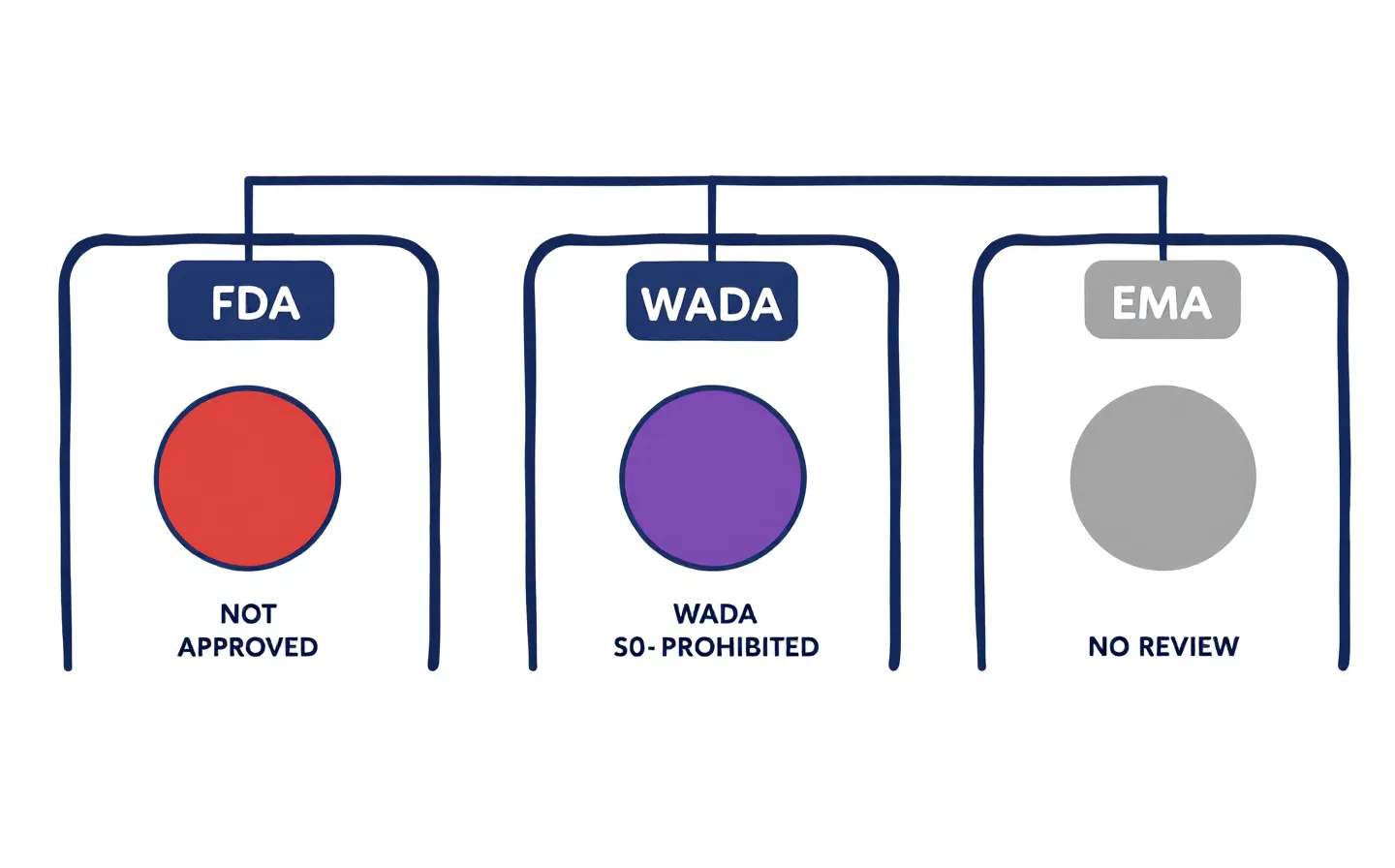
BPC-157 is classified under WADA's S0 Non-Approved Substances category. The S0 category covers any pharmacological substance not approved by a regulatory authority for human therapeutic use. BPC-157 meets that criterion on both counts — it is not approved anywhere, and it is an exogenous pharmacological substance. WADA prohibits it both in-competition and out-of-competition for all athletes subject to the World Anti-Doping Code. This applies regardless of the route of administration or the dose [13].
---
Is BPC-157 FDA approved?
No. BPC-157 has no FDA approval for any human indication. No active Investigational New Drug (IND) application for BPC-157 is publicly listed on the FDA's IND database. The related compound PL 14736 (the topical enema formulation) was studied in Phase 2 for IBD but did not advance to Phase 3 or receive approval.
Research Context
What are the proposed mechanisms behind BPC-157's effects on the nervous system?
In the rodent neurological studies, BPC-157 appears to act through two complementary mechanisms. First, its effects on the nitric oxide system — specifically increasing eNOS-derived NO and decreasing iNOS-derived inflammatory NO — translate to reduced excitotoxicity and improved vascular protection in ischemic neural tissue [5]. Second, in the dopamine system studies, BPC-157 normalized dopaminergic signaling across multiple models of disturbance; the review by Vukojevic et al. (2022) proposes that peripheral NO system modulation achieves central effects through indirect pathways rather than requiring direct BBB penetration [7].
The hippocampal ischemia study specifically documented elevated Egr1 expression — an early response gene involved in neural plasticity and repair — as one of the upstream events in BPC-157's neuroprotective cascade [5].
---
Who has produced most of the BPC-157 research?
The vast majority of published BPC-157 research comes from a single group at the University of Zagreb, led by Sikiric and Seiwerth over several decades. This concentration of origin is acknowledged in the literature and in independent reviews [13][16]. The 2025 narrative review by McGuire et al. notes limited independent replication as a key barrier to translation. He et al. (2022), a Chinese pharmacokinetics group, conducted the principal pharmacokinetic study independently, confirming the linear pharmacokinetic profile [10]. McGuire et al. (2025), a US musculoskeletal medicine group, conducted the narrative review of human data independently [13].
---
What are the main limitations of the current BPC-157 evidence base?
Four limitations are consistently identified in the review literature. First, the rodent-dominant evidence base — the mechanism, dosing, and efficacy data are almost entirely from male Wistar rats and to a lesser extent other rodent species. Second, the concentration of research from one group — independent replication is limited [13][16]. Third, extremely limited human data — 28 participants across three pilot studies, no completed RCTs. Fourth, inconsistent preparation standards — commercial suppliers vary in purity and potency, which complicates any comparison between study conditions [16].
---
What is this site?
This site is an independent editorial resource that publishes structured summaries of the peer-reviewed BPC-157 research literature. It is not a clinic, not a vendor, and not a source of medical advice. It does not accept affiliate relationships with vendors of BPC-157 or any related compound, and does not accept advertising. The full editorial standards are documented at /about.